Crow Lays Out Vision for New American Patriotism at Harvard’s JFK Jr. Forum
CAMBRIDGE, MASS. — Congressman Jason Crow (D-CO)—a combat veteran and member of the House Permanent Select Committee on Intelligence and House Armed Services Committee—spoke at Harvard University’s JFK Jr. Forum about his vision for Building a New American Patriotism. In conversation with Heather Cox Richardson, Congressman Crow discussed what our country can do to come together, protect our democracy, and ensure leaders are accountable to working-class Americans.
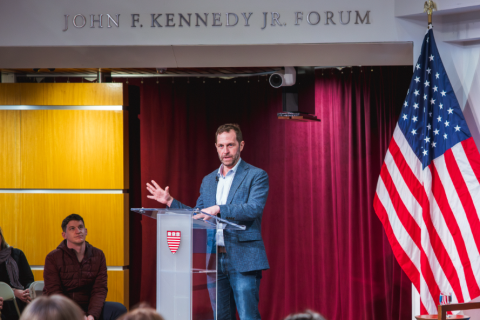
“Our President is laboring under the impression that fear is contagious. He wants people to be gripped by that and to bow down. What I know to be true, and I think what we are seeing happening, is that courage is a lot more contagious than fear. It is spreading like wildfire across this country. There is something big happening. Americans are stepping up, they are protecting their friends, protecting their neighbors, mobilizing, organizing, bearing witness, conducting citizen oversight, and doing amazing things. That’s our country. That is New American Patriotism,” said Congressman Crow.
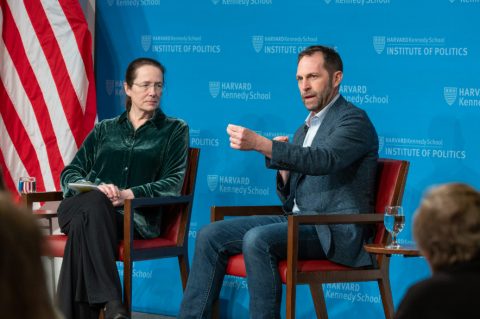
You can watch the full conversation here.
Introductory Remarks from Congressman Crow:
“It's really an honor to be here. Thank you to Ned Price who I’ve known for many years. Katie O’Dair, Aaron Goldman, Director of the JFK Forum, really grateful for the invitation.
“Before Heather and I have our discussion, I wanted to take a moment to share two stories with you that really capture the moment, for me, that I think our country is in. Two stories that I was intimately involved in in my life.
“The first was when I was younger and leading a platoon of paratroopers in the invasion of Iraq. I was in my early twenties. I was thrust into this situation of leading a platoon of paratroopers, 50 of them, that came from every part of this country. They were White, Black, Asian, Hispanic, straight, gay, rich, poor, truck drivers from Ohio, surfers from California, ranchers from Texas. They were a group of paratroopers who had never known each other, came from every facet of this country, and we were thrust together to fight, and putting aside the politics of the war, which we can talk about, that was our mission to come together as a team.
“We had a choice to make: would we focus on those differences, those divisions, or would we come together and become the brothers that we needed to become? We did of course come together. That’s not to say we didn't have our differences and our fights, but we did find common ground, we served together, we had each other's backs, and we all came home together. Still to this day, when I think about America, when I think about what we can be, that unfulfilled promise and the challenges we face, I still think about the faces of those paratroopers.
“Now, fast forward about two decades later, I’m a Member of Congress, and I’m sitting in the House Gallery on January 6, 2021, trapped, surrounded by an insurrectionist mob that was brutally beating the Capitol Police. We had erected barricades to protect ourselves, and we were holding back that mob. And I was thinking to myself, how did we get here? How did I get here 20 years later? Where many of the same veterans that I served with, that I fought with, who had raised their right hand, just like me, that came from rural towns just like I did, be on opposite sides of the same door now one of them trying to harm and kill the other. What happened?
“And I’ve thought about that question, and I’ve thought about two fundamental stories of America. Both important, oftentimes in conflict with each other. One is the story of individual liberty, the cowboy myth, good and bad, but this strand of individual liberty that has taken various forms in our story. And another one, very important, the idea of community, in coming together. And we can both think of many stories that represent both of those and how they are often intentioned.
“I believe this moment that we are in, is in part, not wholly, but in part, a function of the radical imbalance now between those stories, and how people have chosen sides in that narrative.
“So how do we rebalance? How do we reconcile two really important aspects of American society? I believe that it starts, first and foremost, with a call to service.
“Which is why I’m here at the Kennedy School.
“A President who started his career, and is known above all else, for calling people to service. When Americans work together, when they sweat together, fight together, when they strive together, we have been capable of overcoming our differences and finding common ground and doing great things.
“So part of this New American Patriotism that we must find again in this country, is a national call to service for people to start locally, helping their neighbors, helping their friends, and finding the common humanity.
“The second part of this, and this is essential, is a new style of leadership. The old style of leadership is largely dead. This idea that leaders are the smartest people in the room, that they have all of the answers, that they are above everybody else, are untouchable, is gone. What we need now is a style of leadership, a servant leadership, that is grounded in service, that is grounded in humility, and instead of having all the answers, first and foremost, is a convener. That is capable of bringing people together from all different backgrounds, and establishing the conditions for conversation for consensus building, and for the community to come together to solve problems. As a group, that's a very different style.
“So I think with those two things, we can actually spark the notion of the New American Patriotism that will reinvigorate our democracy. We are against the ropes as a country right now. There is no doubt. But there is a path through this that actually will lead to a stronger democracy, a period of democratic enlightenment that can put us in a better place, that actually can fulfill the promise of this country in a way that we have not up until now.”
###